Every key GLP-1 clinical trial: what it tested, who paid for it, and what it found — glp1.how · GLP-1 Guides
Every key GLP-1 clinical trial: what it tested, who paid for it, and what it found
STEP 1, SURMOUNT-4, SELECT, LEADER: GLP-1 trial names get quoted everywhere, usually without context. This reference page lists 205 named, completed GLP-1 trials in one place, grouped by drug and by question, with what each one tested, who sponsored it, its headline result, and a link to the published paper. It also lists the trials that finished but have not reported, and shows who paid for the research.
Updated Sep 20, 2026Evidence-backed
GLP-1 medications are some of the most heavily studied drugs of the past twenty years, and the trial names get quoted everywhere: STEP 1, SURMOUNT-4, SELECT, LEADER. This page lists every named, completed GLP-1 trial we could verify, 205 in all, with what each one tested, who sponsored it, what it found, and a link to the published paper.
It is a reference page, so it is long. Use the links below to jump to a drug or a topic.
STEP is Novo Nordisk's series of trials of weekly semaglutide 2.4 mg (Wegovy) for weight loss, and SURMOUNT is Eli Lilly's series for weekly tirzepatide (Zepbound). Each numbered trial asks a different question. STEP 1 and SURMOUNT-1 tested the drug against placebo in adults with obesity and no diabetes, STEP 2 and SURMOUNT-2 tested it in people with type 2 diabetes, and STEP 4 and SURMOUNT-4 tested what happens when people stop.
Which GLP-1 trial showed the most weight loss?
Among approved drugs, SURMOUNT-1 reported the largest average loss: 20.9% of body weight over 72 weeks on tirzepatide 15 mg, against 3.1% on placebo. In the only head-to-head trial, SURMOUNT-5, tirzepatide produced a 20.2% loss against 13.7% for semaglutide. These are averages, so individual results ranged widely on both sides.
Do GLP-1 drugs protect the heart?
Several large trials found fewer heart attacks, strokes and heart deaths. In SELECT, which enrolled 17,604 people with heart disease and overweight or obesity but no diabetes, these events occurred in 6.5% on semaglutide against 8.0% on placebo. LEADER, SUSTAIN 6, REWIND and SOUL found similar benefits in type 2 diabetes. Not every drug showed it: ELIXA found lixisenatide safe for the heart but no better than placebo.
Who paid for the GLP-1 clinical trials?
Almost all of them were sponsored by the company that makes the drug. Of the 205 trials on this page, 199 were sponsored by drug companies, led by Novo Nordisk with 93 and Eli Lilly with 52. That is normal for prescription drugs, and these were randomized trials, which is the strongest design. It does mean the company chose what to test and what to compare against. Six trials were run by public bodies or universities, including GRADE and the Parkinson's disease trial.
Evidence: For & Against
Both sides of the topic, so you can weigh the evidence yourself.
9Supporting
Revision history
Last updated · 7 revisions recorded.
Show what changed
v7
Body revised
v6
Body revised
v5
Published
v4
Body revised
v3
Common questions 0 → 7
v2
Evidence sources 0 → 13
v1
Improve this page▾
Community notes
Share helpful experiences and questions. Notes are reviewed before publication and do not replace medical advice.
Loading notes…
New submissions are currently paused. Existing approved notes remain available.
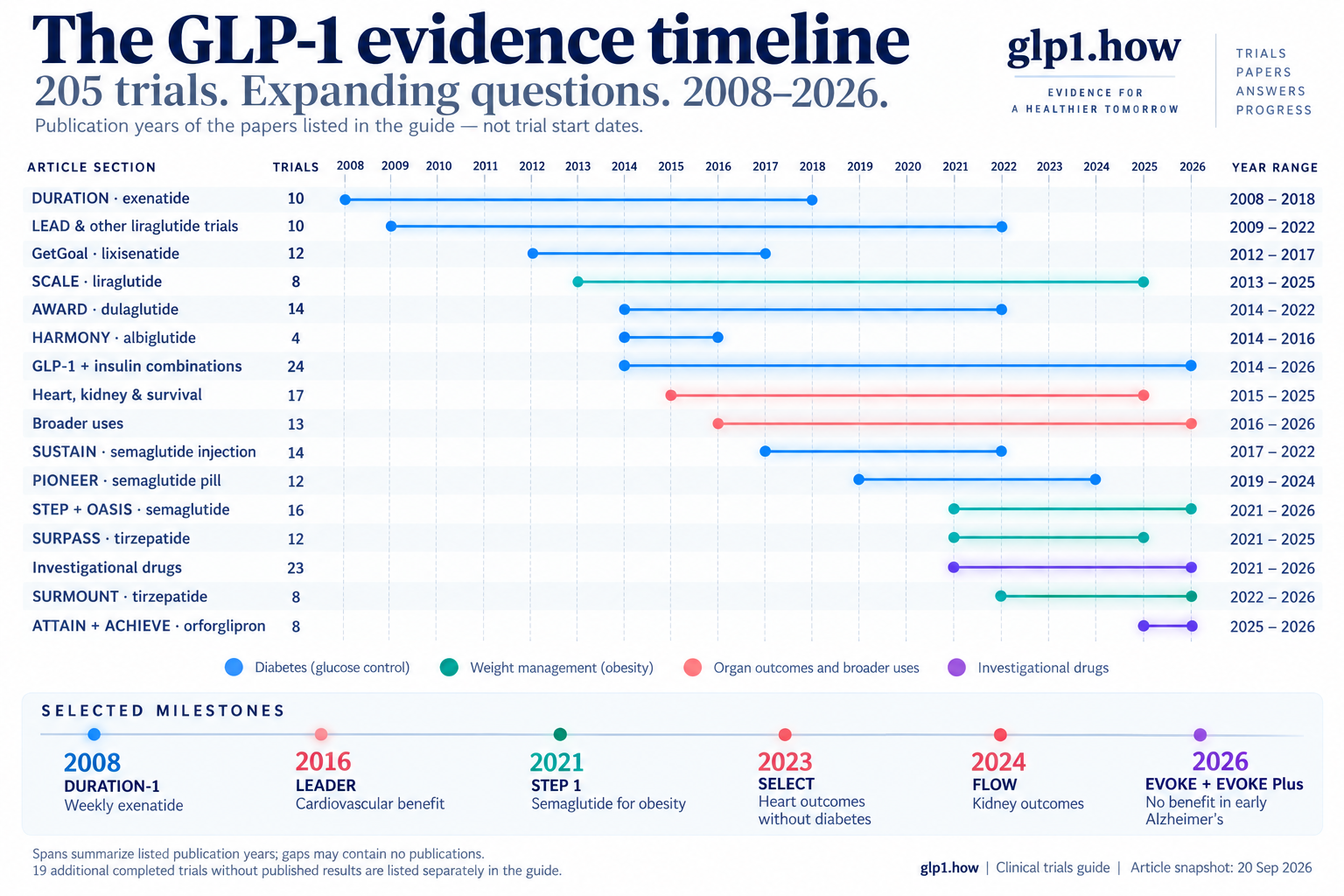
(opens full-size image in a new tab)Timeline chart of 205 GLP-1 trials by article section, showing publication years from 2008 to 2026, colour-coded by diabetes, weight management, organ outcomes and investigational drugs.
How to read this page
Trial links to the trial's official record on ClinicalTrials.gov, the US government registry.
People is the number enrolled, taken from that registry.
Sponsor is the organization the registry lists as running and paying for the trial.
Headline result gives the trial's main finding, using the numbers from the published paper's summary. "Points" of HbA1c means percentage points.
Paper links to the peer-reviewed publication.
Three cautions apply to the whole page.
These are averages. A trial that reports a 15% average weight loss includes people who lost 25% and people who lost almost nothing. A trial result describes a group; it does not predict what will happen to you.
Most of these trials were paid for by the company that makes the drug. That is how nearly all drug trials are funded, and these trials were randomized, which is the strongest design available. It does not make the results wrong. It does mean the company chose what to test, what to compare against, and which results to lead with. The trials run by public bodies and charities are marked in the Sponsor column.
A placebo group is not an untreated group. In weight trials, people on placebo usually get the same diet and activity coaching as people on the drug, which is why the placebo groups often lose a few percent too.
STEP is Novo Nordisk's programme for weekly injected semaglutide 2.4 mg, sold as Wegovy. OASIS tests the same drug as a daily pill. Most trials compare the drug with a placebo injection or pill, with everyone also getting diet and activity advice.
Weekly semaglutide 2.4 mg vs 1.0 mg vs placebo, 68 weeks, adults with obesity and type 2 diabetes
Tirzepatide for weight loss (SURMOUNT)
SURMOUNT is Eli Lilly's programme for weekly tirzepatide, sold as Zepbound. Tirzepatide acts on two gut-hormone pathways, GIP and GLP-1. Two of these trials ask what happens afterwards: SURMOUNT-4 tests stopping, and SURMOUNT-MAINTAIN tests stepping down to a lower dose.
SCALE tested daily liraglutide 3.0 mg, sold as Saxenda, the first GLP-1 approved for weight management. The weight losses are smaller than with the newer weekly drugs above, which is visible in the numbers.
After losing at least 5% on a low-calorie diet, people took daily liraglutide 3.0 mg or placebo for 56 weeks
Orforglipron, the daily pill (ATTAIN and ACHIEVE)
Orforglipron is a GLP-1 pill that is not a peptide, so it needs no food or water restrictions. ATTAIN covers weight loss and ACHIEVE covers type 2 diabetes. ATTAIN-MAINTAIN is the first trial of switching from an injection to a pill; our guide on switching from a GLP-1 injection to a pill covers it in depth.
One-year safety study of three orforglipron doses in Japanese adults with type 2 diabetes (no placebo group)
Heart, kidney and survival trials
These are the largest trials on this page. Instead of measuring blood sugar or weight, they count events: heart attacks, strokes, deaths, kidney failure, hospital stays for heart failure. Regulators required many of them to prove the drugs were safe for the heart; several went further and showed a benefit. A hazard ratio below 1 means fewer events on the drug, so 0.80 means a 20% lower rate.
Newer uses: liver, sleep apnea, joints, brain and more
Trials testing GLP-1 drugs for conditions beyond weight and blood sugar. This section includes some clear failures, which matter as much as the successes: two large trials found no benefit in early Alzheimer's disease, and a smaller one found none in Parkinson's disease.
Daily liraglutide vs placebo added to insulin, 52 weeks, 1,398 adults with type 1 diabetes
1,398
Novo Nordisk
HbA1c fell 0.20 points more than placebo on the top dose, and weight fell 4.9 kg more. Low blood sugar was more frequent, and high blood sugar with ketones doubled on the top dose.
Semaglutide injection for type 2 diabetes (SUSTAIN)
SUSTAIN tested weekly injected semaglutide, sold as Ozempic, mostly against other diabetes drugs. The main measure is HbA1c, a blood test reflecting average blood sugar over about three months. A fall of 1 point, for example from 8% to 7%, is a substantial improvement.
Weekly dulaglutide vs sitagliptin, 52 weeks, adults on metformin
Liraglutide for type 2 diabetes (LEAD and others)
LEAD was the programme behind daily liraglutide, sold as Victoza, approved in 2010. GRADE is included here because it is rare: a large, publicly funded trial that compared liraglutide directly with three other common diabetes drugs.
Publicly funded comparison of four drugs added to metformin (liraglutide, insulin glargine, glimepiride, sitagliptin) in 5,047 people, about five years
7,850
GRADE Study Group (not a drug company); with National Institute of Diabetes and Digestive and Kidney Diseases (NIDDK), National Heart, Lung, and Blood Institute (NHLBI)
Liraglutide and insulin glargine kept HbA1c below 7% longest (about 26 failures per 100 person-years vs 30.4 on glimepiride and 38.1 on sitagliptin).
Exenatide was the first GLP-1 drug. DURATION tested the once-weekly version, sold as Bydureon, against the original twice-daily injection and other diabetes drugs.
Daily lixisenatide vs placebo added to basal insulin, 24 weeks, 311 adults in Asia
Albiglutide (HARMONY)
HARMONY tested weekly albiglutide, sold as Tanzeum. The drug is no longer on the market; our history of GLP-1 medications explains why. Its heart-outcomes trial appears in the heart, kidney and survival section above.
GLP-1 and insulin in one injection (DUAL, LixiLan, COMBINE)
These trials test fixed combinations of a GLP-1 drug and a long-acting insulin in a single pen: IDegLira (Xultophy), iGlarLixi (Soliqua) and the once-weekly IcoSema. The usual question is whether the combination controls blood sugar better than either part alone, with less weight gain than insulin.
None of the drugs in this section is approved in the United States as of September 20, 2026. Results here come from completed, published trials, several of them mid-stage (phase 2) trials that are smaller and shorter than the ones above. Treat them as early evidence. CagriSema combines semaglutide with cagrilintide, an amylin-type drug; retatrutide, survodutide, mazdutide and pemvidutide act on glucagon as well as GLP-1.
Of the 205 trials on this page, 199 were sponsored by drug companies and 6 by public bodies, universities or research networks.
The largest sponsors were Novo Nordisk (93 trials), Eli Lilly (52 trials), Sanofi (23 trials), AstraZeneca (11 trials), GSK (5 trials), Boehringer Ingelheim (3 trials).
The trials not sponsored by a drug company were: Exenatide-PD3 (University College, London), FIGHT (Duke University), GRADE (GRADE Study Group), LEAN (University of Birmingham), REMIT-IDegLira (Population Health Research Institute), RISE Adult (RISE Study Group). Some of these still received the study drug or part of their funding from a manufacturer.
This pattern is normal for prescription drugs, and it is worth keeping in mind. A company decides which questions get a trial. Questions that could shrink sales, such as how low a dose can go or how long someone can safely pause, get studied late or not at all. The few trials on those questions are covered in our guides on stopping a GLP-1 and tapering vs. staying on a maintenance dose.
Finished trials with no published results yet
The registry lists these trials as completed, but we could not find a peer-reviewed results paper linked to them as of September 20, 2026. Some have only a design paper so far. They are listed so the page is honest about what it leaves out. We report no results for them.
We searched ClinicalTrials.gov for completed phase 3 trials of every GLP-1 drug (and phase 2 or 3 trials of drugs still in development) that carry a trial name. We kept company-sponsored trials with at least 90 participants and other trials with at least 150, which leaves out small single-hospital studies. For each trial we found the main results paper on PubMed, mostly through the registration number the paper reports, and added well-known trials that the registry search missed.
Sponsor, enrollment and completion status come from the registry. Results come from each paper's published summary; where we could not read the full paper, the summary is all we had. Every paper link was checked against the publisher's record, and every number in the results column was checked against the paper's summary.
The page will date. Trials finish, results get published, and drugs in the last section get approved or abandoned. Last verified: September 20, 2026. If you spot an error or a missing trial, use the report link on this page.
Study findings are attributed to their authors and were located via PubMed; trial records are from ClinicalTrials.gov. This page is general education and peer information, not medical advice. A trial result is not a prediction for one person; decisions about your treatment belong with the prescriber who knows your history.
Have any GLP-1 trials failed?
Yes. Two large trials of the semaglutide pill in early Alzheimer's disease, EVOKE and EVOKE Plus, found no benefit: dementia scores worsened by the same amount as on placebo. A trial of exenatide in Parkinson's disease also found no benefit, and the FIGHT trial found liraglutide did not help people recently hospitalised with advanced heart failure. Several drugs were also shown to be safe for the heart without proving a benefit.
What is a hazard ratio?
A hazard ratio compares how often an event, such as a heart attack, happened in the group taking the drug with the group taking placebo. A value of 1 means no difference. A value of 0.80 means the event rate was 20% lower on the drug, and a value above 1 means it was higher. It describes a group over the length of the trial and is not a prediction for one person.
Why do people on placebo lose weight in these trials?
Because a placebo group is not an untreated group. In most weight trials everyone receives the same diet and physical activity coaching, and people on placebo typically lose a few percent of their body weight. In STEP 3, where everyone received intensive behavioural therapy and a low-calorie diet, the placebo group lost 5.7%. The drug's effect is the difference between the two groups.
Daily liraglutide 3.0 mg vs placebo plus lifestyle therapy, 56 weeks, adolescents aged 12 to 17
251
Novo Nordisk
BMI fell about 4.6 percentage points more than placebo. 10.4% stopped liraglutide because of side effects vs none on placebo, and BMI rose faster after stopping.
Daily liraglutide vs placebo, 48 weeks, 52 people with fatty liver disease with inflammation (phase 2)
52
University of Birmingham (not a drug company); with Wellcome Trust, Novo Nordisk
Liver inflammation resolved in 9 of 23 (39%) vs 2 of 22 (9%). Small, early trial; funded by charities, the UK health research institute and Novo Nordisk.
Daily IDegLira vs each component alone, 52 weeks, 819 Japanese adults
819
Novo Nordisk
Blood sugar control was better on the combination than on either drug alone. Weight rose 2.9 kg on the combination vs 4.1 kg on insulin, and fell 1.0 kg on liraglutide.
Cardiovascular outcomes trial (CVOT) — A large randomized trial built specifically to measure a drug's effect on heart attacks, strokes, and cardiovascular death rather than on surrogate markers like blood sugar or weight.
MACE (major adverse cardiovascular events) — A composite trial endpoint bundling cardiovascular death, non-fatal heart attack, and non-fatal stroke into a single outcome.
Related guides
Switching from a GLP-1 injection to a pill to keep the weight off: what the first trial found — If you've lost weight on Zepbound or Wegovy and want off the weekly injection, can a daily pill hold your results? One randomized trial has now tested exactly that. Here's what it found, how much weight people kept, what the switch felt like, and the big question the trial didn't answer.
GLP-1 myths vs. facts: what the media and social feeds get wrong — A plain-language, evidence-checked look at the most common claims about GLP-1 medications circulating in the news and on social media — sorting what's false, what's true, and what's genuinely unsettled, with the studies behind each verdict.
What the ADA guidelines say about GLP-1 medications — and what changed for type 1 diabetes in 2026 — The American Diabetes Association's Standards of Care is the reference most US clinicians follow, and it now puts GLP-1 medications at the center of treating diabetes with obesity. Here's what the guideline actually recommends — GLP-1s as the preferred obesity medication in type 2 diabetes, realistic weight-loss targets, the "highest dose isn't always the goal" point on dosing — plus the headline 2026 change: for the first time, the ADA cautiously supports GLP-1 therapy for people with type 1 diabetes and obesity, with important safety guardrails.